Why Golf Simulator Practice Is the Quiet Revolution We Love in Palestine, Texas
For decades, improving your golf game meant battling the weather, booking a tee time, and hoping the driving range wasn’t packed. But something has changed. At Grip It & Rip It Golf, we’ve watched golf simulator practice quietly reshape how players of every skill level sharpen their swings. This is the story of how golf simulators are quietly transforming the way we practice, and it’s no longer a luxury reserved for tour pros or country clubs with deep pockets. Right here in Palestine, Texas, everyday golfers are logging more meaningful practice reps than ever before, and they’re doing it with data-backed precision.
What makes this shift so exciting is how approachable golf simulator practice has become. You step inside, grab a club, and immediately get feedback that used to require a swing coach and expensive equipment. In this article, we’ll walk you through exactly how golf simulators are transforming practice, what the numbers reveal, and why we believe this is the future of golf improvement.
The Problem With Traditional Practice (And What We’ve Learned)
We’ll be honest: traditional range practice has a lot of weaknesses that most golfers never think about. You hit a bucket of balls, watch them fly into a field, and guess how far each one traveled. There’s no real feedback loop, and most of us end up reinforcing the same flaws over and over.
After working with hundreds of golfers in our community, we’ve identified the biggest limitations of old-school practice:
- No accurate distance data. Judging carry distance by eye is nearly impossible, especially beyond 150 yards.
- Weather dependency. East Texas summers bring brutal heat, and winter rain can shut down outdoor sessions for days.
- Zero shot tracking. You can’t improve what you don’t measure, and range buckets don’t record anything.
- Mindless repetition. Without targets or structure, many golfers just “bang balls” without intention.
Studies in motor learning consistently show that practice with immediate, specific feedback leads to faster skill acquisition than unstructured repetition. The traditional range simply can’t provide that. That’s the gap golf simulator practice fills so effectively, and it’s exactly how golf simulators are quietly transforming the way we practice. It’s why we’ve centered so much of what we do around this technology.
How Golf Simulator Practice Delivers Instant, Usable Feedback
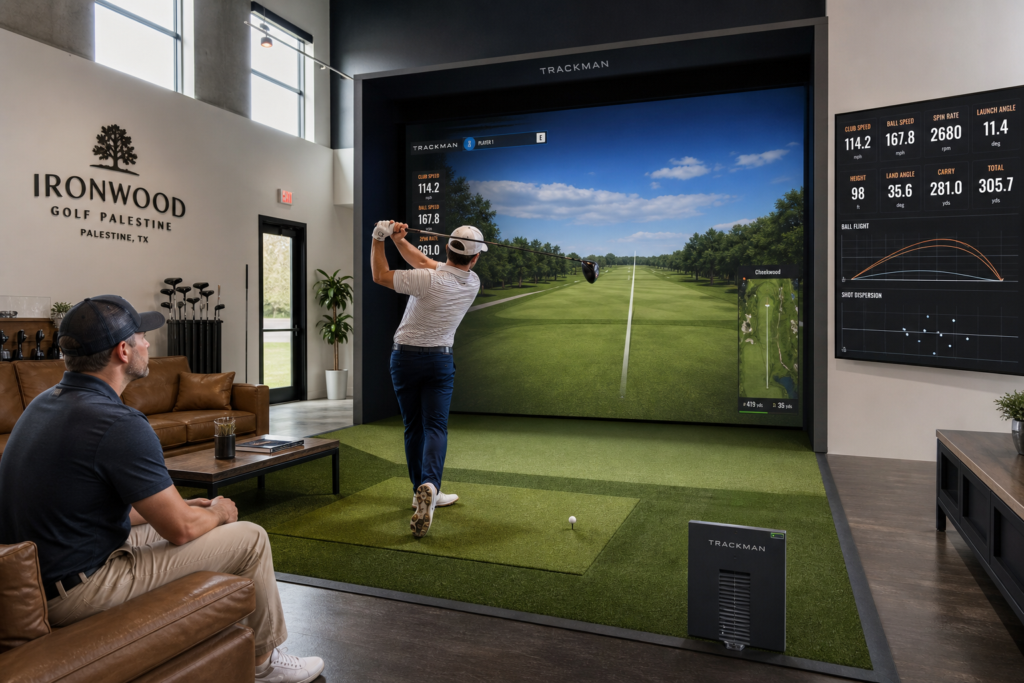
The single biggest advantage of golf simulators is the data. Modern launch monitors like Trackman, Foresight, and SkyTrak capture a staggering amount of information about every single shot, and that information turns guesswork into genuine coaching. When one of our members hits a shot, they instantly see numbers that would have cost a fortune to measure a generation ago.
The Metrics That Actually Change Your Game
Not every statistic matters equally, but a handful of them transform how you understand your golf swing. Here are the ones we focus on most during golf simulator practice:
- Clubhead speed – the engine behind your distance, measured precisely on every swing.
- Ball speed and smash factor – revealing how efficiently you’re transferring energy at impact.
- Launch angle and spin rate – the hidden keys to optimizing carry distance and stopping power.
- Carry and total distance – finally knowing your real yardages with each club.
- Shot dispersion and attack angle – seeing your consistency pattern and swing path instead of guessing.
Here’s a real example we love sharing. A golfer came to us convinced their 7-iron traveled 165 yards. After a few golf simulator practice sessions, the data showed their true average carry was 148 yards. That single insight corrected their club selection on the course and immediately dropped strokes off their score. That’s the power of measurable feedback.
When you can see your spin rate climbing too high or your launch angle sitting too low, you stop guessing and start making targeted adjustments. We’ve seen golfers fix in one afternoon what took them years to struggle with on the range. This is how golf simulators are quietly transforming the way we practice, one measurable swing at a time.
Practicing Year-Round in Palestine, Texas
One of the most underrated benefits of indoor golf simulator practice is that it never closes due to weather. In Palestine, Texas, we deal with sweltering summer afternoons, surprise thunderstorms, and chilly winter mornings that make outdoor practice uncomfortable or impossible. Golf simulators remove every one of those obstacles.
Think about how much practice time the average golfer loses to conditions. If you can only play when the weather cooperates, you might get in twenty solid sessions a year. With indoor golf simulator practice, that number can easily triple. More quality reps means faster improvement, and consistency is what builds a repeatable swing.
We also find that climate control changes the quality of practice itself. When you’re not fighting the heat or squinting into the sun, you can focus entirely on your mechanics. Here’s what year-round access unlocks for the golfers we work with:
- No seasonal rust. Your golf swing stays grooved through the offseason instead of degrading over the winter.
- Comfortable, focused sessions. Air conditioning and consistent lighting let you concentrate on improvement.
- Flexible scheduling. Early mornings, late nights, or lunch breaks all become practice opportunities.
- Play famous courses virtually. Many golf simulators let you play digital versions of Pebble Beach, St. Andrews, and more.
That last point deserves attention. Instead of hitting the same shots repeatedly, you can simulate real course conditions, practice course management, and develop a strategic mindset. Golf simulator practice bridges the gap between the range and the first tee in a way nothing else can.
Structured Practice Plans That Actually Work
Technology alone won’t lower your scores. What makes golf simulator practice so transformative is how it enables structured, purposeful training. We encourage every golfer to practice with a plan rather than just swinging aimlessly, and golf simulators make that easy to execute.
Our Favorite Simulator Practice Drills
Here are structured golf simulator practice drills we recommend to golfers who want to make every session count:
- Gapping sessions. Hit ten shots with each club and record your average carry. Build a personal yardage chart you can trust on the course.
- Dispersion challenges. Aim at a specific target and track how tightly your shots cluster. Challenge yourself to shrink that group over time.
- Pressure games. Set up closest-to-the-pin competitions with friends to replicate the stress of real putts and approach shots.
- Full-course rounds. Play a complete eighteen holes to practice decision-making, not just swing mechanics.
- Speed training. Dedicate a block of swings to maximizing clubhead speed while monitoring the numbers for real gains.
The beauty of this approach is accountability. Because every shot is measured, you can’t fool yourself about progress. You’ll know within a session whether your adjustment is working, and that feedback keeps you motivated.
We’ve seen golfers who struggled for years suddenly break through once they adopted structured golf simulator practice. The combination of instant data and intentional drills creates a learning environment that the traditional range simply can’t match. It turns practice from a chore into something genuinely engaging, and it shows exactly how golf simulators are quietly transforming the way we practice.
Why Golf Simulator Practice Fits Every Skill Level
A common misconception we hear is that golf simulators are only for serious or advanced players. Nothing could be further from the truth. In our experience, golf simulator practice benefits beginners just as much as low handicappers, and often more.
For newcomers, the simulator removes intimidation. There’s no crowd watching, no pressure, and no embarrassment about a shank or a topped ball. New golfers can learn fundamentals at their own pace while getting friendly, honest feedback. That safe environment accelerates learning and keeps beginners coming back.
For experienced players, the value lies in fine-tuning. When you’re already shooting in the seventies or eighties, improvement comes from small, precise adjustments. The detailed data from golf simulator practice helps you dial in spin rates, optimize launch conditions, and tighten dispersion in ways that would be nearly impossible outdoors.
Here’s how the benefits break down across skill levels:
- Beginners: Learn fundamentals in a pressure-free setting with instant visual feedback.
- Intermediate players: Build reliable yardages and iron out inconsistencies in ball-striking.
- Advanced players: Optimize launch conditions and sharpen course strategy for lower scores.
- Families and groups: Enjoy golf together regardless of individual skill, making it a social experience.
We genuinely believe golf simulators have democratized golf improvement. The technology that once lived only in elite training facilities is now accessible to anyone who wants to get better, right here in our community. That broad access is central to how golf simulators are quietly transforming the way we practice.
The Data Behind the Transformation
We don’t just rely on gut feeling when we say golf simulators improve golf games. The broader trends in the sport back it up. Indoor golf and simulator usage have grown dramatically in recent years, and the National Golf Foundation has reported rising participation driven largely by off-course options like golf simulators. You can explore more about these participation trends through the National Golf Foundation, which tracks how technology is bringing new players into the game.
What’s driving this growth? It comes down to results and accessibility. When golfers get measurable feedback, they improve faster, and faster improvement keeps them engaged. We’ve watched this cycle play out countless times with the golfers we serve through golf simulator practice.
Consider the practical advantages that the data consistently highlights:
- More practice volume. Year-round access means significantly more reps per year.
- Higher practice quality. Every shot is measured and analyzed for continuous learning.
- Faster feedback loops. Adjustments are tested and confirmed within minutes, not weeks.
- Better retention. Engaging, game-like practice keeps golfers coming back consistently.
The quiet transformation isn’t hype. It’s a measurable shift in how effectively people can learn and enjoy golf. And because the technology behind golf simulators continues to improve in accuracy and realism, that advantage only grows stronger over time.
Bringing It All Together for Your Game
The way we practice golf has fundamentally changed, and most people are only beginning to realize it. Golf simulator practice delivers instant data, eliminates weather excuses, enables structured training, and welcomes players of every skill level. Combined, these benefits create a practice experience that’s faster, smarter, and genuinely more enjoyable than the traditional range ever offered. That’s precisely how golf simulators are quietly transforming the way we practice.
At Grip It & Rip It Golf, our passion is helping golfers in Palestine, Texas discover just how much better they can get when they practice with purpose and precision. We’ve seen beginners fall in love with the game and seasoned players finally break through plateaus, all thanks to the quiet power of golf simulator practice.
If you’re ready to stop guessing and start improving with real feedback, we’d love to have you experience golf simulator practice for yourself. Come see how enjoyable and effective practice can be when the data is on your side. Visit us at https://gripitripit247golf.com to learn more and book your time today. Your best round yet is waiting, and it starts with a single swing.