
Golf Simulator Practice & Technology
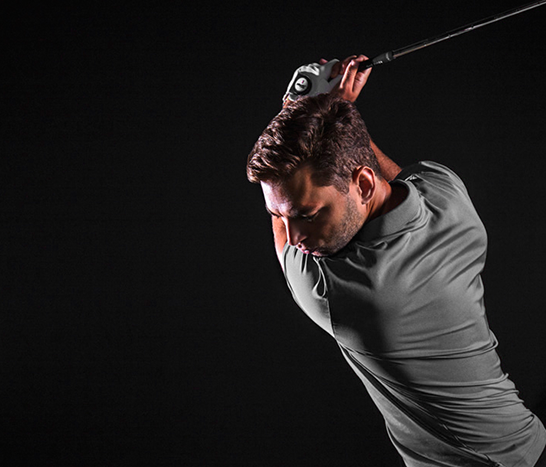
Practice With a Plan, Not Just a Bucket of Balls
There’s a difference between hitting balls and actually practicing. Hitting balls is repetition — swing, watch it fly, swing again. Practicing with a plan means knowing what you’re working on, having a way to measure whether it’s improving, and being able to look back on a session and know exactly what changed. TrackMan technology at Grip It & Rip It Golf is what turns a normal practice session into that second kind of practice — the kind with actual data behind it.
This isn’t about entertainment value or playing a fun round with friends. It’s for golfers who want to walk out of a session having genuinely learned something specific about their swing, backed by numbers instead of a feeling.
What TrackMan Actually Measures
Every swing you take in a bay gets captured by radar and camera tracking that reads more than 20 data points per shot. That includes ball speed, launch angle, spin rate, smash factor, club path, face angle, carry distance, total distance, and shot dispersion across multiple swings with the same club. Instead of watching a ball fly and guessing what happened, you get the actual mechanics of that shot laid out in front of you.
This matters because feel is unreliable. A shot that felt terrible sometimes measures better than one that felt perfect. Chasing feel alone means you can spend months reinforcing a swing flaw that felt fine the whole time. Data removes that blind spot. You see the club path that’s actually producing your miss, not the one you assumed was happening.
Building a Practice Session Around One Goal
The golfers who improve fastest with simulator practice aren’t the ones hitting the most balls — they’re the ones who walk in with one specific thing to work on. Maybe it’s tightening wedge distances so 100-yard shots stop coming up short or long. Maybe it’s finding out why your driver keeps starting left of target. Maybe it’s just building consistency with a 7-iron before moving up the bag.
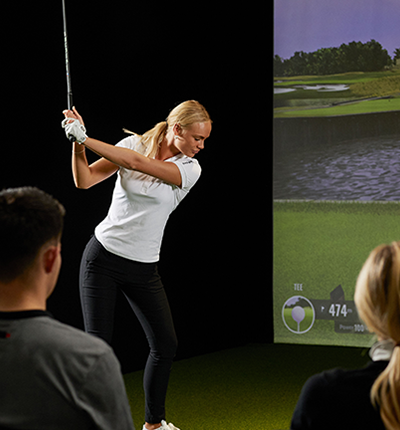
A structured session usually starts with a handful of shots with your current setup to establish where things stand, then moves into focused reps on the one thing you came in to fix. Because the bay is private and the data updates after every swing, you can make a small adjustment, hit a few more shots, and immediately see whether that adjustment moved the numbers in the direction you wanted — all inside the same hour.
Tracking Progress Across Multiple Sessions
A single session tells you what’s happening right now. Coming back regularly and comparing sessions over weeks or months is what tells you whether you’re actually getting better. Because every shot is measured the same way, session to session, you can look at your dispersion pattern from a month ago against today and see real change instead of relying on memory of how things used to feel.
This is especially useful heading into a specific goal — lowering your handicap, prepping for a tournament, or just wanting proof that the time you’re putting in is paying off. Members who practice on a consistent schedule get the most out of this, since regular sessions create an actual timeline of data to compare against rather than isolated snapshots.
Replacing Guesswork With Real Feedback
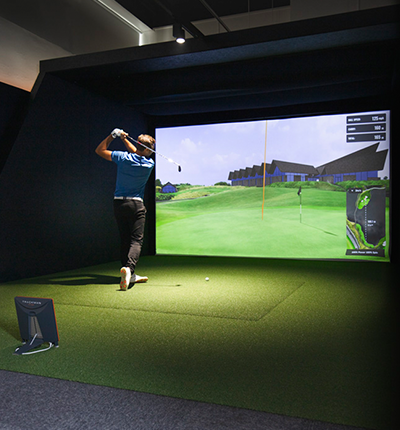
Outdoor range sessions leave a lot of room for self-deception. It’s easy to convince yourself a bad round was bad luck, or that a good shot means the swing change worked, when the sample size is really too small to know either way. Simulator practice removes a lot of that guesswork because the feedback is immediate and specific to that exact swing.
If a shot missed right, the data shows whether that came from face angle, path, or both — instead of leaving you to guess whether it was your grip, your alignment, or something else entirely. That specificity is what makes it possible to actually fix a problem instead of randomly adjusting things and hoping one of them helps.
Practice That Fits Real Improvement Goals
Whether you’re working toward a lower handicap, prepping for league play, or just tired of the same miss showing up round after round, structured simulator practice gives you a way to actually measure whether the work is translating into results. It’s not about hitting more balls — it’s about hitting the right shots, with the right feedback, often enough to see the pattern change.
Using a Golf Simulator as a Driving Range Replacement
Many golfers use the simulator the same way they would use a driving range—but with better information. You warm up, work through the bag, and focus on specific shots. The difference is that the simulator tells you exactly what happened instead of leaving you to guess.
That’s why more golfers are replacing traditional range sessions with golf simulator practice. You spend more time learning and less time wondering. When practice is efficient, golfers practice more often. When golfers practice more often, scores drop.

Your New Favorite Golf Spot Awaits
Start Practicing With Real Data Behind It
- 2212 Crockett Road Suite 200, Palestine, Texas 75801
Book your simulator bay today and start playing the game your way.